
Every SEO agency will tell you the best time to start was yesterday.
That's not advice, that's a sales pitch.
The real answer is a bit more nuanced, and it could be the difference between owning your category organically or paying for every click forever.
The most common advice about when to invest in SEO as an ecommerce brand is that you should start when you have consistent revenue, or when paid channels are hitting diminishing returns, or when you want to reduce CAC over time, or when you have a content team to support it.
And all of that is either inaccurate or oversimplified.
The Two Failure Modes
An aftermarket ecommerce store hires an SEO agency. Six months later, all they’ve gotten are reports showing activity. A list of pages optimized, maybe some random scores go up, maybe traffic and keywords improve.
... but they still have no idea how – or if – any of this is connected to revenue.
So eventually they conclude SEO doesn't work and go back to running ads.
Sound familiar?
In this entire chain, nobody asked whether search was the right investment for their brand, at that stage, in that category.
Which means you’re either wasting marketing budget that could have driven profit elsewhere, or you’re losing organic revenue to competitors who’re laughing all the way to the bank.
Let's fix that.
The Second Engine
But first, there’s a really important question you need to answer:
Why does organic revenue even matter in the first place?
Seriously.
Real question.
If you’re already profitable with your existing channels, why even bother? If it ain't broke...
Well, have you ever seen a Cessna 172?
Tiny plane, single propeller at the front, seats four people. The design is so successful that the Cessna 172 is the most-produced aircraft of all time, ever.
So why don’t long-haul airlines use the same design? Just scale it up with more seats and a bigger engine?
For a lot of reasons, but importantly, it’s because of what happens when the engine fails.
If you're flying with a single engine from New York to London, and your engine fails over the pond, your plane is about to become a submarine very quickly.
But if you have two engines and one fails, you can troubleshoot.
You can limp home on the remaining engine.
If the odds of one engine failing is, say, 1 out of 100,000, then for two engines:
Odds of two engines failing: 1/100,000 * 1/100,000 = 1/10 billion
Real-world failures aren’t perfectly independent, but the principle holds: a second engine dramatically reduces the odds of losing all power.
Now here's the thing:
If CPMs spike, a campaign breaks, or an iOS update wrecks your attribution – suddenly, revenue dies out.

Organic search is your second engine. It's not invincible. Nothing is.
But it fails for completely different reasons than paid ads fail.
When Meta has a bad week, your organic rankings needn’t move. And when Google updates its search algorithm, your ad costs needn’t spike.
That's the real value of a second channel that isn't built on the same mechanics as the first: risk mitigation.
And at its best, organic traffic converts at rates that paid ads rarely match, because the buyer came looking for you, not the other way around.
With that out of the way, here's the framework to figure out how — or if — you should be investing in SEO.
And yes, this framework still holds even in the era of AI search.
(By the way, if you’re worried about AI search, consider the fact that when your prospects use AI bots to figure out what they need, currently, AI bots currently don’t click on ads — but they do click on organic search results. Something to think about.)
The Revsku Aftermarket SEO Matrix
There are two variables that determine how much search should matter to your brand.
How many people are searching for what you sell – that's volume. And how many competitors are fighting for those clicks – that's competition.
Those two variables put you in one of four positions.
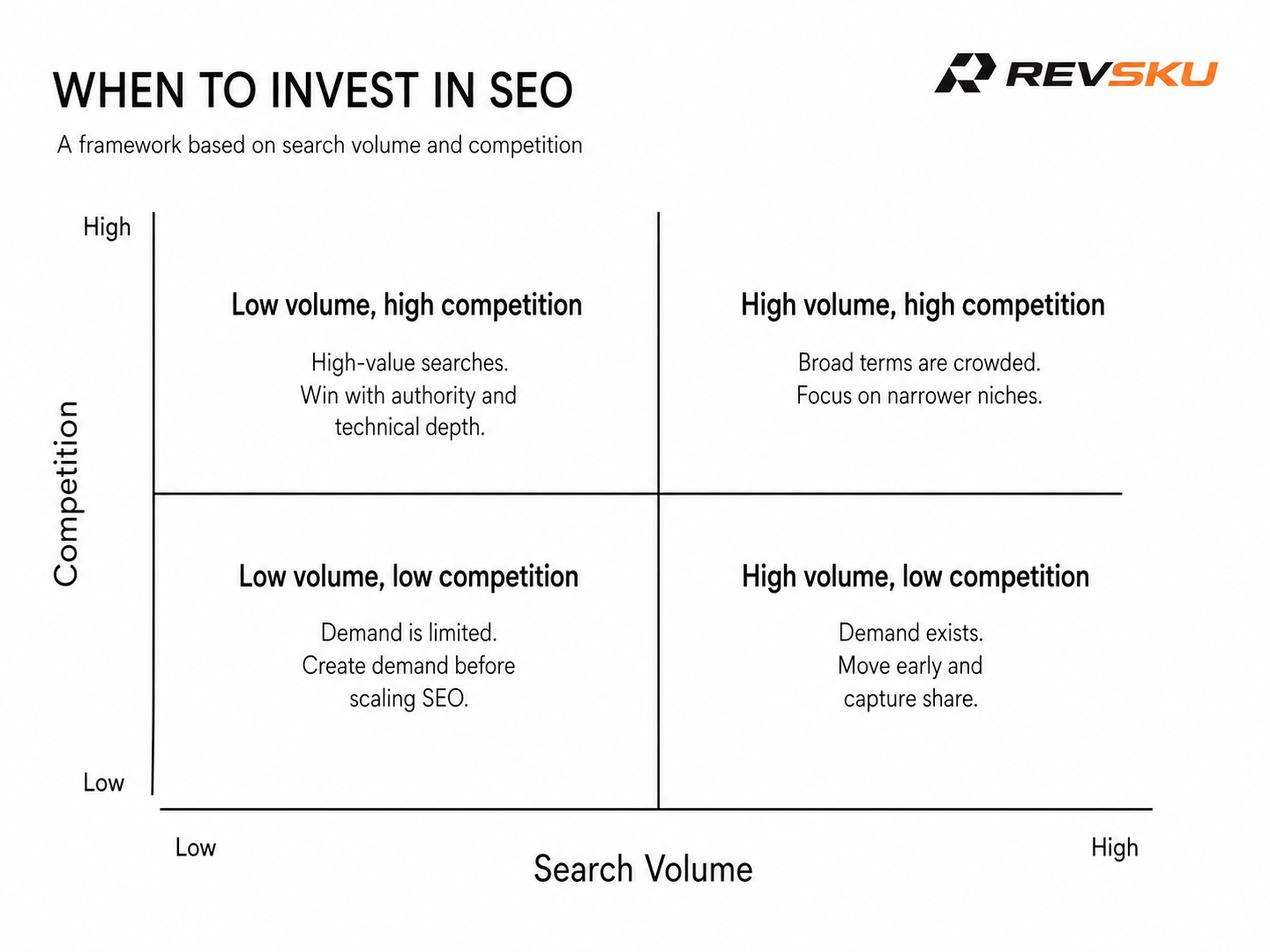
1. High volume, low competition
This is the arbitrage window, where most stores would love to be.
It's when demand has outrun the market's ability to respond to it. In the automotive niche, this happens on a predictable schedule.
Like when a new generation of a popular vehicle drops, and owners are immediately on Google searching for mods, fitment info, exhaust comparisons.
Most aftermarket suppliers won't have caught up; their pages would still reference the previous generation, and not mentioning the new model year at all.
The brand that moves first owns that traffic for months. Sometimes for the entire first year of that vehicle's existence.
That window closes quickly. But while it's open, traffic is easy and the buyers are ready.
If you’re here, start SEO immediately. Every hour you wait is market share you're handing to whoever moves quicker.
You don't need a perfect strategy here; you just need to be faster than your competitors.
2. High volume, high competition
This is the commodity zone.
"Spark plugs." "Floor mats." "LED headlights."
Enormous search volume, enormous competition. The margins on these generic terms have been competed down to near zero.
If this is where you are, you're in a war you probably can't win, unless you’re fundamentally structured for economies of scale, like Amazon.
But this position has arbitrage hiding inside it.
Nobody's fighting hard for "exhaust drone fix 5th gen 4Runner."
Few have built a genuinely useful page for "best slip-on exhaust Kawasaki Z900 under a thousand dollars."
The generic term is a commodity, but the make + model + problem-specific term usually isn't.
Build enough of these specific pages and the small volumes compound.
You'll be in a space your competitors have ignored because they decided the individual numbers don't look impressive on a spreadsheet.
3. Low volume, low competition
This is the innovative product position: you're niche enough that the searches aren't really happening.
Maybe nobody even knows that they have a problem yet, so they aren’t looking for solutions. The thing is, you can't build meaningful search revenue on volume that doesn't exist.
If you’re here, don't spend your budget on SEO yet.
Use it on paid social. Prove that the audience exists.
When branded search volume starts appearing, that's your signal. Then, SEO has something to amplify.
Before that point, you're building on sand.
4. Low volume, high competition
The is the premium clicks quadrant, with scarce, high-value, heavily contested terms.
"Titanium full system Ducati V4R." "Carbon fiber hood GT500."
Small total volume, but everyone knows the person clicking has serious money and serious intent.
You can win here, but not on product pages alone.
Brand reputation and genuine technical depth are what separate you from the next player.
How exactly you can build these two things are topics for several other posts.
Where to From Here?
Now that you understand this, you can determine when you should and shouldn’t invest in SEO for your aftermarket brand.
And unless you're in quadrant 3, the next question is: what's actually limiting your organic revenue right now.
That’s exactly what RevSku’s hidden money diagnostic is: I personally record a deep dive video analysis of your automotive ecommerce store — based on your platform, your catalog structure, and your ranking potential — to identify five immediately-actionable, untapped organic revenue opportunities that you can implement right away to stop losing sales to competitors.
Right now, you can request one completely for free, but it won’t always be free. So if you’re interested, it's a good time to check it out now.