
This week:
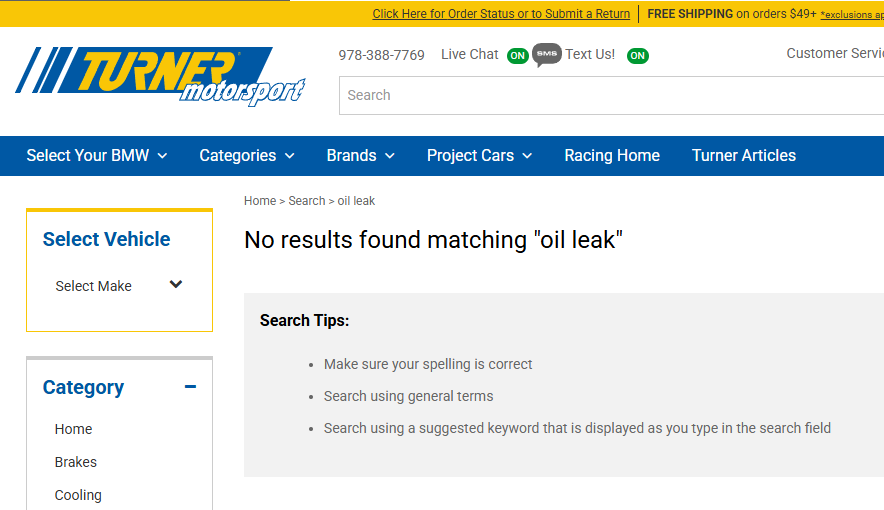
In a test of 131 ecommerce sites, most failed at several basic on-site search query types, including a parts retailer that returned nothing for "oil leak." An AI agent will grab a competitor's price the second yours takes too long to load. Most brands mentioned in a first AI answer are gone by the second question. And a Trustpilot page with a 1.3-star rating is what shows up when a brand hasn't bothered to own its own reviews page.
Why your customer gave up on your site
Somebody searches "oil leak" on CarParts.com. A real customer with a real symptom, typing the exact words a mechanic would use.
The site returns nothing useful, even though they have dozens or hundreds of relevant products.
Baymard caught this in their 2026 search benchmark, and this kind of failure is sneaky — it doesn't leave a mark in your analytics. It just looks like a bounce, the same bounce you'd get from someone who was never going to buy anything in the first place.
That's the thing about search UX. Unlike with, say, a homepage button, when search UX fails, it's most often failing users who were already trying to give you money.
Baymard's 2026 ecommerce search benchmark, which tested 131 major sites, breaks search failures into eight query types, and 56% of sites mess up at least one of them badly enough to lose the customer.
For aftermarket stores, these two are most important:
Symptom searches
"Oil leak," "won't start," "grinding brakes," and so on.
The customer's working backward from a problem, not forward from a part number. If your search engine only matches product titles, these queries return nothing, or worse, a pile of irrelevant results that make it look like you don't carry the part at all.
Compatibility searches
"Brake pads Silverado," for instance. Or a part number copy-pasted from a forum post.
This one's even closer to a purchase decision. The customer's already decided what they need, they're just confirming you carry it.
Getting this wrong costs you at the finish line, right before checkout, which is a more expensive place to lose someone than the top of the funnel.
Here's how to find out if you're losing sales on either of these, and how to fix it if you are.
Troubleshooting your site search
- Search your own site for five or six real symptom phrases — the ones customers actually say, not the ones you'd type as the person who knows the catalog. See what comes back.
- Try a raw compatibility query: a part number pasted exactly as it'd appear on a forum, or "[part] for [year make model]" in messy, non-ideal phrasing.
- If your platform logs search queries (most Shopify and BigCommerce search apps do), pull the list sorted by zero-result or low-click searches. That's a direct record of the problem, not a guess.
- Better still, hand your site to someone who's never used it and ask them to find a part starting from a symptom. Where they get stuck is the real friction point — you already search your own site the "correct" way, which hides the problem from you.
Fixing the issue
There isn't a quick-fix, but the revenue gains can be worth the squeeze (think about it: a search bar that actually works is so important to users that Google built a trillion dollar company perfecting just that one product.)
Symptom search needs an actual list built somewhere – common problems tagged to the parts that solve them, then plugged into your search app's synonym or tagging system so those tags actually surface in results.
If you're on Shopify, that's usually a search app with tagging support (Searchanise, Boost, and similar all handle this), not something native to the platform.
Compatibility search is a smaller lift if you've already got a YMM or VIN selector. The fix is often just making sure a raw part number or a messy pasted query gets routed into that same system instead of falling into generic keyword search, which doesn't know what to do with it.
Budget a few hours to run the audit. The fix itself, especially symptom tagging across a real catalog, is more of a project than a weekend task, but it's work that a small team can scope and do without outside help.
Resources worth your time this week
🤖 AI agents will grab a competitor's price the moment yours won't load — Siteline ran a Claude agent against 100 B2B sites hunting for pricing. Every time pricing sat behind JavaScript or a sales-contact wall, the agent didn't wait. It went to a competitor's page instead.
Worth checking whether this applies to you: view page source (not 'Inspect Element', that shows the rendered page, not unrendered source code) on your pricing or fitment pages and search for the actual number. If it's not sitting in the raw HTML, it loaded in after the fact, which is exactly the pattern that trips these agents up.
⭐ 17 of 30 major ecommerce brands don't rank for their own "brand + reviews" search — As Freddie Chatt explains, when a brand doesn't own their reviews page, Trustpilot or Reddit does. And whatever's sitting there is what shows up, good or bad or wildly unrepresentative.
Worth checking if your review app (Judge.me, Yotpo, Loox, Stamped, whatever you're on) can generate a standalone reviews page. Some do it in a couple of clicks, others need a workaround or don't support it at all.
📉 62% of brands AI recommends in a first answer are gone by the second question — Clovion tested this across 69,120 conversations. Ask the same question twice, the list barely moves. Add one plain detail — "for a small team," or in our world, "for a 2019 model" — and 62% of brands disappear.
Easy to test yourself: ask ChatGPT or Claude a product question in your category, see if you come up, then ask a follow-up with a specific vehicle detail and see if you're still there.
📑 29% of ecommerce sites still hide core product content behind horizontal tabs — Shoppers scanning for "specs" or "compatibility" info walk right past a tab with that exact label on it, repeatedly, even while actively looking for it. Technical products take the biggest hit here, which covers most of what you sell.
Pull up one of your best-selling product pages and check: is fitment or spec info sitting in a tab, or is it visible without a click?
📊 The one content format that actually gets cited by AI — Growth Memo dug through citation data and found something specific: only 2.7% of cited pages were original research, but that sliver pulled 3.3x the citation rate of everything else.
Almost all of it was one format — a named, head-to-head comparison. "Brand A vs. Brand B vs. Brand C on stopping distance" beats a generic "best brake pads" post every time. If you're going to build one piece of content this quarter, that's the shape to build it in.